Friday, July 30, 2010

Elaphe obsoleta

Elaphe obsoleta


Black Rat Snake
Conservation status

Least Concern (IUCN 3.1)
Scientific classification
Kingdom:Animalia
Phylum:Chordata
Subphylum:Vertebrata
Class:Reptilia
Order:Squamata
Suborder:Serpentes
Family:Colubridae
Genus:Elaphe
Species:E. obsoleta
Binomial name
Elaphe obsoleta
(Say In James, 1823)

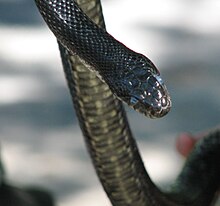
The Black Rat Snake (Elaphe obsoleta) — also called pilot black snake or simply black snake — is a non-venomous colubrid species found in North America. It prefers heavily wooded areas and is known for having excellent climbing ability, including the ability to climb the trunk of large mature trees without the aid of branches. No subspecies are currently recognized.

Description

Elaphe obsoleta obsoleta, Murphys Point Provincial Park, Ontario

Adults can become quite large and are known to reach up to eight feet, being the largest snake found inCanada. The record length is 101 inches (2,600 mm), making it (officially) the longest snake in North America. Unofficially, indigo snakes (Drymarchon corais) are known to exceed them, and one wild caught pine snake (Pituophis melanoleucus) with a portion of its tail missing measured 111 inches (2,800 mm).

Behavior

When startled, they may freeze and wrinkle themselves into a series of kinks. If they feel further threatened, they may flee quickly or vibrate their tails in dead leaves (a form of mimicry, to make it sound like a rattlesnake). They are also capable of producing a foul smelling musk which they will release onto a predator if picked up. They spread the musk with their tail in hopes of deterring the threat.

Feeding

This species is a constrictor, meaning it suffocates its prey, coiling around small animals and tightening its grip until they can no longer draw breath, before eating them. Though they do consume mice and rats, the Black Rat Snakes will also hunt other snakes, chipmunks, squirrels, birds, and bird eggs.

Reproduction

The male snake wraps its tail around the female with their vents nearly touching. Males then erect their sex organ, the hemipenis, and insert it into the female sex organ, cloaca. The mating lasts about a few minutes or a few hours. The female lays about 12 to 20 eggs after five weeks and they hatch about 65 to 70 days later.

Taxonomy

Black Rat Snake, Great Smoky Mountains,Tennesee

Utiger et al. (2002) argued that North American Rat Snakes of the genus Elaphe are a monophyletic group and thus separate from Old World members of the genus. They therefore resurrected the available name Pantherophis Fitzinger for all North American taxa (north of Mexico). In addition, they change the spelling for the specific name to obsoletus.

Crother et al. (2003) rejected the taxonomic change to Pantherophis, preferring to retain the current concept of Elaphe and the spelling obsoleta.


.

Rat snake


Rat Snake
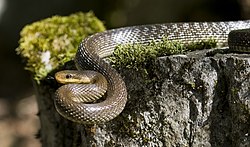
An Aesculapian Snake, Zamenis longissimus
Scientific classification
Kingdom:Animalia
Phylum:Chordata
Subphylum:vertebrata
Class:Reptilia
Subclass:Diapsida
Infraclass:Lepidosauromorpha
Superorder:Lepidosauria
Order:Squamata
Infraorder:Serpentes
Family:Colubridae
Genus:Various

Rat snakes are medium to large constrictors that can be found through a great portion of thenorthern hemisphere. They feed primarily on rodents and birds and, with some species exceeding 10 feet, they can occupy top levels of some food chains. Many species make attractive and docile pets and one, the corn snake, is one of the most popular reptile pets in the world. Other species can be very skittish and sometimes aggressive but bites are seldom serious and no species of ratsnake is dangerous to humans. They were long thought to be completely nonvenomous, but recent studies have shown that at least some Old World species do possess small amounts of venom (amounts so small as to be negligible to humans).

Previously most ratsnakes were assigned to the genus Elaphe but many have been since renamed following mitochondrial DNA analysis performed in 2002. For the purpose of this article names will be harmonized with the TIGR Database. When searching for information on a particular species of ratsnake it might be useful to query the old name, Elaphe sp., as well as the new.v

Taxonomy

In recent years there has been some taxonomic controversy over the genus of North American ratsnakes. Based on mitochondrial DNA, Utiger et al. (2002) showed that North American Rat Snakes of the genus Elaphe along with closely related genera such as Pituophis andLampropeltis form a monophyletic group separate from Old World members of the genus. They therefore suggested the resurrection of the available name Pantherophis Fitzinger for all North American taxa (north of Mexico).

All published taxonomy remains a taxonomic suggestion until ruled on by the International Commission on Zoological Nomenclature (ICZN -http://www.iczn.org/), but the body has so far not supported the change and has not addressed the taxonomic suggestion, thus the official taxonomy remains Elaphe.


Crother et al. (2003) rejected the taxonomic change to Pantherophis, preferring to retain the current concept of Elaphe and the spellingobsoleta.


Milk Snake

Milk Snake


Milk Snake
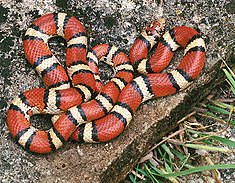
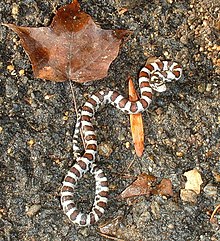
Red milk snake Lampropeltis triangulum syspila
Scientific classification
Kingdom:Animalia
Phylum:Chordata
Class:Reptilia
Order:Squamata
Suborder:Serpentes
Family:Colubridae
Genus:Lampropeltis
Species:L. triangulum
Binomial name
Lampropeltis triangulum
LaCépède, 1788[1]

The Milk Snake (Lampropeltis triangulum; French: Couleuvre tachetée; Spanish: Culebra-real coralillo, Lithuanian: Pieninė gyvatė) is a species of king snake. There are 25 subspeciesamong the milk snakes, including the commonly named scarlet kingsnake (L. t. elapsoides).The subspecies have strikingly different appearance, and many of them have their own common names. Some authorities suggest that this species may be split into several separate species. They are distributed from southeastern Canada, through most of the continental United States, to Central America, down to western Ecuador and northern Venezuela of northern South America. They grow 20 to 60 inches (51 to 150 cm) long.

Appearance

Milk snakes have smooth and shiny scales and their typical color pattern is alternating bands of orange-black-yellow or white-black-orange. However, red blotches instead of bands are seen in some populations. Some milk snakes have a striking resemblance to coral snakes and this mimicry (known as Batesian mimicry) likely scares away potential predators. While both milk snakes and coral snakes possess transverse bands of red, black and yellow, a common mnemonic can be used to properly distinguish between the deadly coral snake and the harmless milk snake:

  • "Red on yellow, deadly fellow; Red on black, venom lack."
  • "Red next to black is a friend of Jack; red next to yellow will kill a fellow."
  • "Red to yellow, kill a fellow. Red to black, venom lack."
  • "If red touches black, you're okay Jack; if red touches yellow, you're a dead fellow."
  • "Red next to black, venom I lack; red next to yellow, run away fellow."
  • "Red and black, friend of Jack; red and yellow kill a fellow."
  • "Red touches yellow, Not a nice fellow; if red touches black, good friend of jack."
  • However, the Eastern Milk Snake (L. t. triangulum) does not resemble a coral snake; instead it tends to have similar markings to that of several other snakes, particularly the fox snake and thescarlet snake. There is enough distinction among the three to make the Eastern Milk Snake fairly easy to identify. Eastern Milk Snakes also have a light colored v-shaped or y-shaped patch on their neck. One subspecies is melanistic (almost all black).

    Snakes have no eyelids and instead have a transparent covering that rests over their eyes calledbrilles to protect their eyes from dust and dirt. The brilles give them a "glassy-eyed" blank appearance.

    Habitat

    Across the wide range of this species, habitat varies. Typically, milk snakes live in forested regions, however, in some regions they can be located in open prairies. In various parts of across its distribution, milk snakes often abide in rocky slopes.

    Behavior

    Milk snake activity is mostly nocturnal. They are primarily terrestrial, except the scarlet kingsnake which is known to take shelter under the bark of standing dead trees. They also try to blend in with dead leaves.

    Diet

    Young milk snakes typically eat slugs, insects, and earthworms. Adult diet frequently includes lizards (especially skinks), and small mammals. They are also known to eat birds and their eggs, frogs, fish, and other snakes.

    Milk snakes are much more opportunistic eaters than the fox snake or corn snake. They have been known to consume a variety of animalsincluding rodents, eggs, birds, reptiles, amphibians, and invertebrates. Nevertheless the diet of an adult milk snake still primarily consists of rodents. They are nocturnal eaters and are often found during the day in old barns and under wood.

    An early myth about milk snakes is that they suck cow udder to get the milk. The myth is entirely false, and is discredited since[1] the milksnake does not have the physical capabilities to suck milk out of a cow. Milksnakes are, however, frequently found in and aroundbarns, making use of their cool and dark environments, and for the easily accessed populations of rodents[1] to feed on. This proximity to barns, and therefore cows, probably gave rise to the myth.

    Reproduction

    Milk snakes are oviparous, laying an average of about 10 eggs per clutch, although that number may vary by region. The milk snake mates from early May to late June. In June and July, the female lays three to twenty-four eggs beneath logs, boards, rocks, and rotting vegetation. The eggs incubate for approximately two months, and hatch around August or September. Milk snakes typically live around

    twelve years.

    Conservation status

    The milk snake is not listed by the IUCN (a wildlife conservation union), but in some areas, they may face significant pressure due to pet trade collection.[1] Because this species' high value in the pet trade, many subspecies are now being bred in captivity for sale.


Copperhead

copperhead1
The Copperhead is a stout-bodied snake that feeds on cicadas, caterpillars, mice, birds, frogs and lizards. It prefers to live in wooded areas, among rocks, or near streams or ponds because prey are more plentiful in such locations. Favorite hiding places include stone walls, sawdust, mulch or compost piles, and and under decaying stumps, in wood piles, under abandoned building debris, and under large flat stones. This snake will be seen basking during the day when weather is cool but not cold. During summer heat, it will stay hidden during the day and become active at night. In October the Copperhead retreats to its underground den to hibernate until late February or early March. Dens are most often in rocky hillsides with southern or eastern exposure to the sun. These "snake dens" will be returned to year after year and may contain a large number of snakes. In late summer through mid-October, between 1 and 14 young are born alive rather than hatched from eggs.

HOW DANGEROUS ARE COPPERHEAD SNAKES?

A Copperhead snake bite needs medical attention, is extremely painful, and may cause extensive scarring and loss of use. Many people are bitten while trying to kill or handle the snake. Don't take chances -- avoid these snakes.
"Copperhead bites are typically not fatal," says Dr. Peter Bromley, N. C. Cooperative Extension Specialist in Zoology. Small animals, like small dogs, may receive a fatal bite from a copperhead. The venom causes local tissue destruction and secondary infection often sets in. If you or your pet are bitten by any snake that you suspect is venomous, get medial attention immediately. For the most part, if you let snakes alone, they'll leave you alone.

North Carolina has the dubious distinction of the most venomous snake bites of any state in the U.S. Many of these bites could be prevented by avoiding the snake instead of trying to kill it or pick it up. Avoid Copperhead snakes! Allow it to go on its way undisturbed. Copperheads bite more people in most years than any other U.S. species, but they also have the mildest venom. University of Georgia Professor Dr. Whit Gibbons is conducting research to learn why copperheads inflict the most bites.

All the snake species tested have had the same initial response to human presence. If given the opportunity, they escape--down a hole, under a ledge, or in the case of cottonmouths, into the water. Escape is even the standard behavior of enormous diamondback rattlesnakes, which will immediately disappear if they have enough warning before they think a person can reach them.

But often escape is not possible, so most snakes hold their ground, ready to defend themselves. A difference between copperheads and the other species appears in the next phase, when they are approached. Most rattlesnakes vibrate their tails and most cottonmouths sit with mouth open when a human comes near. Even some non-venomous snakes vibrate their tails. These displays are merely warnings not to tread on them. They are not aggressive attack measures. The snakes just want us to leave them alone.

So far, the dozens of cottonmouths Dr. Gibbons stood beside have made threat displays but have not bitten the researcher's boot. The same has been true for canebrake rattlesnakes although too few have been tested to declare that they are as passive as cottonmouths. The exciting news (at least for the researchers) is that the copperhead is different from the others. Most copperheads tested have struck out immediately when they felt threatened.

This behavior explains why more people receive legitimate snakebites from copperheads than from any other species of venomous snake in North America. Still to be investigated is another aspect of copperhead bites: many are not serious enough to require more than minor medical treatment. This may be so not only because the venom of a copperhead is significantly less potent than that of rattlesnakes or cottonmouths, but also because they seldom inject much venom.

The copperhead's initial threat display is to strike. It lashes out at an enemy as a warning. If the enemy is close enough, the fangs may penetrate the skin. However, because this is a threat display, not an attempt to kill, the snake injects little venom. A copperhead has no intention of wasting valuable venom if it can scare away the menace with a minor bite.

Keep in mind, however, that even a non-fatal bite needs medical attention, is extremely painful, and may cause extensive scarring and loss of use. Don't take chances-- avoid these snakes.

What Does A Copperhead (snake) Look Like?

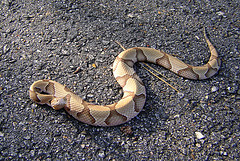
Copperheads are one of the most poisonous snakes when it bites. They can be identified by the triangle head and copper bands merged with white and brownish color bands. Copperhead's eyes look like cat eyes. Their head is wider as compare to normal snake. Mature snakes can be 2 to 3 feet long. Baby copperheads look like grown up adult snakes but have yellow colored tails. A copperhead den in the winter is in rock ledge where they can crawl into the hill in order to stay warm.

Copperhead snakes are likely found in high grass, trash and vines. They freeze when danger is near so it is easy to step on them. They only attack when they left with no other option. Their bite is very painful and may damage the tissue if not treated on time.

Some common symptoms of copperheads bite include puncture marks, fang marks, swelling and redness near the bite, sweating, vomiting, nausea and pain near the bite. The majority bites are extremely hurting within 5-10 minutes and after that startswelling.

Copperheads are calm snakes that do not normally strike unless they feel threatened. Their normal adult size is in the 2-3 foot range, and their venom is very mild compared to the other north american pitvipers.
The best course of action if you happen to encounter one is leave it alone. Most people are bitten while trying to catch them or kill them.


How Can I Tell It's A Copperhead Snake?

"The Copperhead comes in
several color variations, depending on the location, from bright copper
and light through to very dark brown shades.

Copperheads
are usually colorful and strikingly patterned snakes. The background
color of the back and sides is tan to pinkish. There are darker,
chestnut colored bands across the back and sides. Each hourglass shaped
band is of varying width.

Newborn
Copperheads are colored and patterned like adults, excepting the last
inch of so of the tail which will be a bright, sulfur yellow color.

Virtually all adult still retain the copper color head, which gives it its name.
When adult they are moderately sized snakes, normally reaching 2–4 feet, with thick, heavy bodies.
The copperhead bite is not usually fatal in adults, but very painful and often lasting discomfort is the result.
Parents
who have seen their children go through the pain and suffering a
copperhead bite can cause; it is something nobody would wish to
experience again.

Bite
symptoms include intense pain, tingling, throbbing, swelling, and
severe nausea. Damage can occur to muscle and bone tissue, especially
when the bite occurs in the outer extremities such as the hands and
feet, areas in which there is not a large muscle mass to absorb the
venom."

Can A Copperhead Snake Be Blue?

Most snakes will have a hazy, or smoky-gray appearance when they are getting ready to shed, but as far as being bright blue, no, not a Copperhead. Even when in shed Copperheads will still have that distinctive pattern.

What Are The Adaptations Of A Copperhead Snake?

Scales that keep its skin from drying out.