
HOW DANGEROUS ARE COPPERHEAD SNAKES?
North Carolina has the dubious distinction of the most venomous snake bites of any state in the U.S. Many of these bites could be prevented by avoiding the snake instead of trying to kill it or pick it up. Avoid Copperhead snakes! Allow it to go on its way undisturbed. Copperheads bite more people in most years than any other U.S. species, but they also have the mildest venom. University of Georgia Professor Dr. Whit Gibbons is conducting research to learn why copperheads inflict the most bites.
All the snake species tested have had the same initial response to human presence. If given the opportunity, they escape--down a hole, under a ledge, or in the case of cottonmouths, into the water. Escape is even the standard behavior of enormous diamondback rattlesnakes, which will immediately disappear if they have enough warning before they think a person can reach them.
But often escape is not possible, so most snakes hold their ground, ready to defend themselves. A difference between copperheads and the other species appears in the next phase, when they are approached. Most rattlesnakes vibrate their tails and most cottonmouths sit with mouth open when a human comes near. Even some non-venomous snakes vibrate their tails. These displays are merely warnings not to tread on them. They are not aggressive attack measures. The snakes just want us to leave them alone.
So far, the dozens of cottonmouths Dr. Gibbons stood beside have made threat displays but have not bitten the researcher's boot. The same has been true for canebrake rattlesnakes although too few have been tested to declare that they are as passive as cottonmouths. The exciting news (at least for the researchers) is that the copperhead is different from the others. Most copperheads tested have struck out immediately when they felt threatened.
This behavior explains why more people receive legitimate snakebites from copperheads than from any other species of venomous snake in North America. Still to be investigated is another aspect of copperhead bites: many are not serious enough to require more than minor medical treatment. This may be so not only because the venom of a copperhead is significantly less potent than that of rattlesnakes or cottonmouths, but also because they seldom inject much venom.
The copperhead's initial threat display is to strike. It lashes out at an enemy as a warning. If the enemy is close enough, the fangs may penetrate the skin. However, because this is a threat display, not an attempt to kill, the snake injects little venom. A copperhead has no intention of wasting valuable venom if it can scare away the menace with a minor bite.
Keep in mind, however, that even a non-fatal bite needs medical attention, is extremely painful, and may cause extensive scarring and loss of use. Don't take chances-- avoid these snakes.
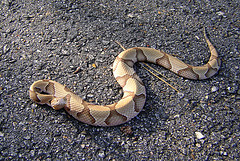
What Does A Copperhead (snake) Look Like?
Copperhead snakes are likely found in high grass, trash and vines. They freeze when danger is near so it is easy to step on them. They only attack when they left with no other option. Their bite is very painful and may damage the tissue if not treated on time.
Some common symptoms of copperheads bite include puncture marks, fang marks, swelling and redness near the bite, sweating, vomiting, nausea and pain near the bite. The majority bites are extremely hurting within 5-10 minutes and after that startswelling.
How Can I Tell It's A Copperhead Snake?
several color variations, depending on the location, from bright copper
and light through to very dark brown shades.
Copperheads
are usually colorful and strikingly patterned snakes. The background
color of the back and sides is tan to pinkish. There are darker,
chestnut colored bands across the back and sides. Each hourglass shaped
band is of varying width.
Newborn
Copperheads are colored and patterned like adults, excepting the last
inch of so of the tail which will be a bright, sulfur yellow color.
Virtually all adult still retain the copper color head, which gives it its name.
When adult they are moderately sized snakes, normally reaching 2–4 feet, with thick, heavy bodies.
The copperhead bite is not usually fatal in adults, but very painful and often lasting discomfort is the result.
Parents
who have seen their children go through the pain and suffering a
copperhead bite can cause; it is something nobody would wish to
experience again.
Bite
symptoms include intense pain, tingling, throbbing, swelling, and
severe nausea. Damage can occur to muscle and bone tissue, especially
when the bite occurs in the outer extremities such as the hands and
feet, areas in which there is not a large muscle mass to absorb the
venom."

No comments:
Post a Comment