Rat snake
| Rat Snake | |
|---|---|
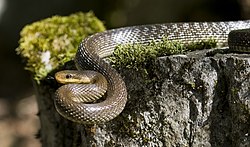 | |
| An Aesculapian Snake, Zamenis longissimus | |
| Scientific classification | |
| Kingdom: | Animalia |
| Phylum: | Chordata |
| Subphylum: | vertebrata |
| Class: | Reptilia |
| Subclass: | Diapsida |
| Infraclass: | Lepidosauromorpha |
| Superorder: | Lepidosauria |
| Order: | Squamata |
| Infraorder: | Serpentes |
| Family: | Colubridae |
| Genus: | Various |
Rat snakes are medium to large constrictors that can be found through a great portion of thenorthern hemisphere. They feed primarily on rodents and birds and, with some species exceeding 10 feet, they can occupy top levels of some food chains. Many species make attractive and docile pets and one, the corn snake, is one of the most popular reptile pets in the world. Other species can be very skittish and sometimes aggressive but bites are seldom serious and no species of ratsnake is dangerous to humans. They were long thought to be completely nonvenomous, but recent studies have shown that at least some Old World species do possess small amounts of venom (amounts so small as to be negligible to humans).
Previously most ratsnakes were assigned to the genus Elaphe but many have been since renamed following mitochondrial DNA analysis performed in 2002. For the purpose of this article names will be harmonized with the TIGR Database. When searching for information on a particular species of ratsnake it might be useful to query the old name, Elaphe sp., as well as the new.v


Taxonomy
In recent years there has been some taxonomic controversy over the genus of North American ratsnakes. Based on mitochondrial DNA, Utiger et al. (2002) showed that North American Rat Snakes of the genus Elaphe along with closely related genera such as Pituophis andLampropeltis form a monophyletic group separate from Old World members of the genus. They therefore suggested the resurrection of the available name Pantherophis Fitzinger for all North American taxa (north of Mexico).
All published taxonomy remains a taxonomic suggestion until ruled on by the International Commission on Zoological Nomenclature (ICZN -http://www.iczn.org/), but the body has so far not supported the change and has not addressed the taxonomic suggestion, thus the official taxonomy remains Elaphe.
Crother et al. (2003) rejected the taxonomic change to Pantherophis, preferring to retain the current concept of Elaphe and the spellingobsoleta.

No comments:
Post a Comment